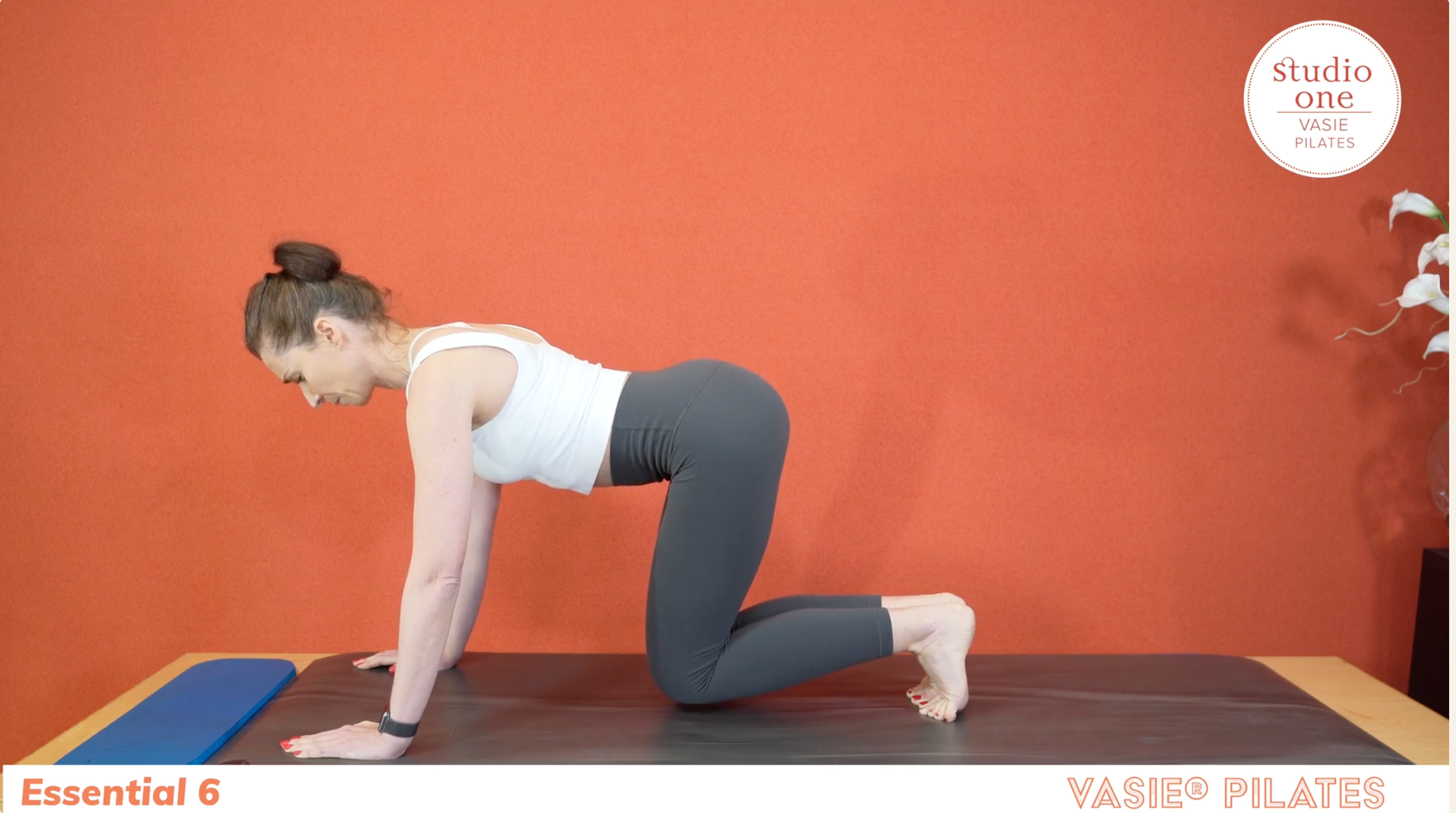
Pilates for Lower Back Pain: Why Flattening Your Back Backfires
Sep 28, 2026
Low Abs, Glutes & Stability Month
Pressing your back into the mat is a cue with a purpose — and a posture with a cost. Six years on, Dana found out what the cost was. Read her case study.
By Ana Kokaurova, Certified Advanced Rolfer®, Stott-certified Pilates instructor, VASIE® Instructor Trainer · September 28, 2026 · 8 min read
The short version
"Imprint" or a posterior pelvic tilt — tucking the pelvis and pressing the lower back toward the floor — is a legitimate Pilates and fitness tool for specific moments used in many forms of exercise and is frequently intended to protect the low back. But...held habitually during exercises and done haphazardly - this movement flattens the natural curve of the lumbar spine, (your natural shock absorber!!) hands the load to ligaments instead of muscle, teaches the deep back muscles to turn off and bulges/shortens the abs - frequently having the opposite long term effect we are looking for from exercise. That is a reliable recipe for a back that keeps hurting and abs that still stick out and don't support your spine. So why do so many fitness programs still cue to push your back into the mat? because it easy to "feel the burn" in your abs. If you are here, reading this, you are probably past this short term association burn=good, let's dig in and learn how to get healthy, long term results and no shortcuts.
Every joint has a neutral: the position of least strain, where the muscles on both sides are balanced. Back pain that returns usually means the body has lost the ability to find it. Joint neutral can be retrained. It takes a method, and it takes months.
The deep dive
Six years of Pilates, and a back that wouldn't quit
Dana moved to Alaska and had done Pilates before. She ran marathons until her late thirties, when her lower back began to end her runs before her legs did. Physical therapy helped for a while. Then someone suggested Pilates, and for six years she went to a mat class twice a week (out of state) and did exactly what she was told: pull the navel in, tuck the tailbone, press the lower back into the floor. She got very good at it. She could feel the burn in every workout. She could hold a hundred without shaking.
And her back still hurt. Standing at a party hurt. Driving hurt. Sitting through a movie meant a hand pressed into the small of her back by the second act. She came to Studio One at forty-eight convinced Pilates had made her worse, and she was half right. As many experienced Pilates enthusiasts, Dana was not happy when I told her she HAD to do a Pilates 101 class to even take a regular class at the studio. She considered herself a Pilates expert...and so did I, she knew all the moves but I wanted to make sure she had two things right 1. Breathing 2. Neutral/Imprint - if breathing and micro-movement is off I knew she wouldn't get the results she has been striving for. As a fellow runner, I really wanted to help her rediscover the joy and freedom of running without pain. After all we were the same age I felt compelled to help and guide her.
Dana is like many runners and lifters I have taught. But the flat, hard, sore back she walked in with is one I can usually spot from across the room.
Watch Video and Follow Along to Learn More about Imprinting Correctly: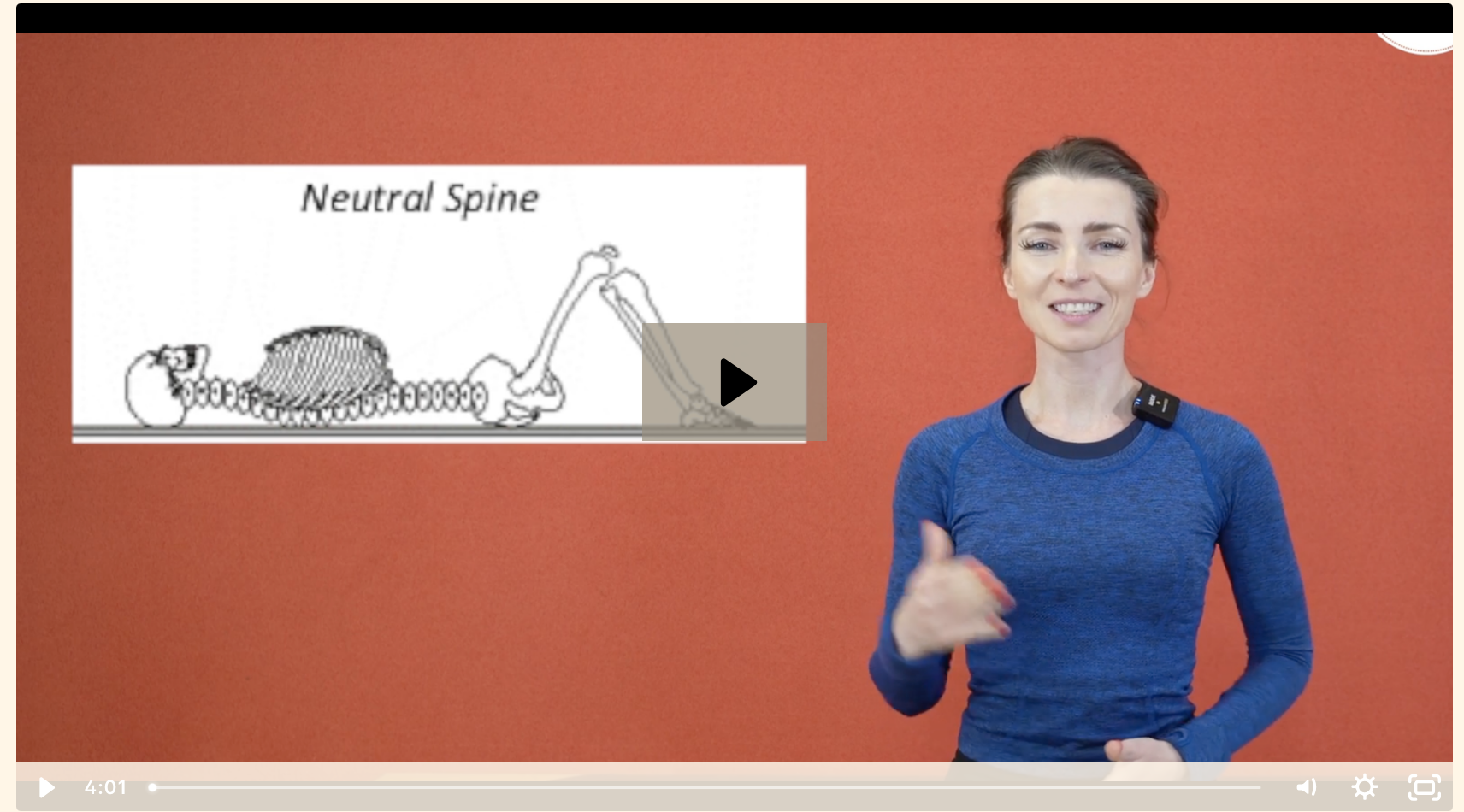
What imprint is for
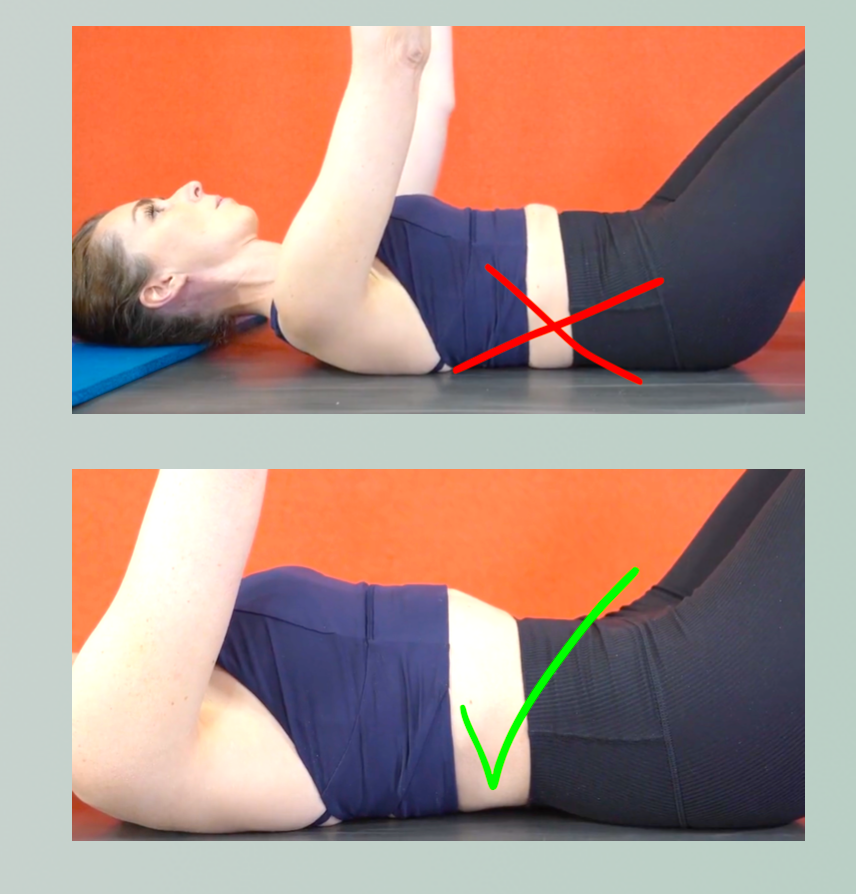
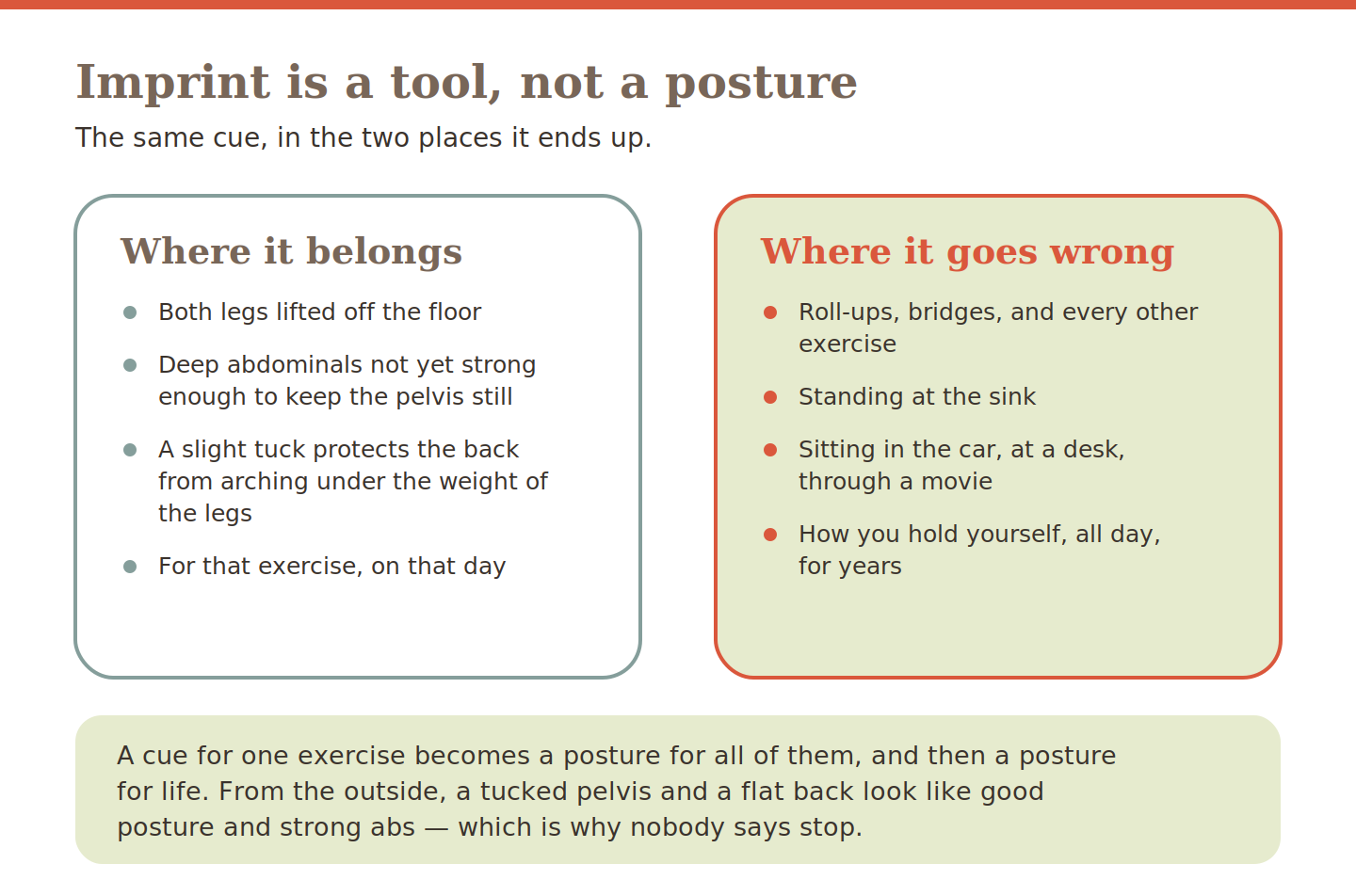
I am Stott-certified and VASIE® Pilates certified and imprint is part of that vocabulary. It is not a mistake. When both legs are lifted off the floor and the deep abdominals are not yet strong enough to keep the pelvis still, lengthening the low back into a slight tilt is what protects the lower back from arching under the weight of the legs. Used that way, for that exercise, it is good teaching. It is also the first mistake I list in our free abdominal course, because of what happens next. (see link at the bottom of page for free tutorial)
What happens next is that a cue for one exercise becomes a posture for all of them, and then a posture for life. Dana imprinted during roll-ups, during bridges, standing at the sink, and sitting in the car. The tuck had become how she held herself. Nobody had told her to stop, because from the outside a tucked pelvis and a flattened back look like good posture and strong abs. So the first Pilates 101 she came to we worked on differentiating how to imprint only using the deep core NOT the legs, not the glutes, not the feet! while she found it difficult to do at first, being an attentive client she figured out how to do imprint by lengthening the spine instead of jamming it into the mat. she exclaimed and "aha" that I will never forget "so I only imprint as far as I can do with my core!!" and "is soooo much smaller than I thought" After this I knew she was on the right track and would get a whole new level of fitness and pain control regardless of where she did Pilates. I loved this for her and after a 6 month follow up she reported doing the Skinny Raven 5 k with no pain. Mission accomplished.
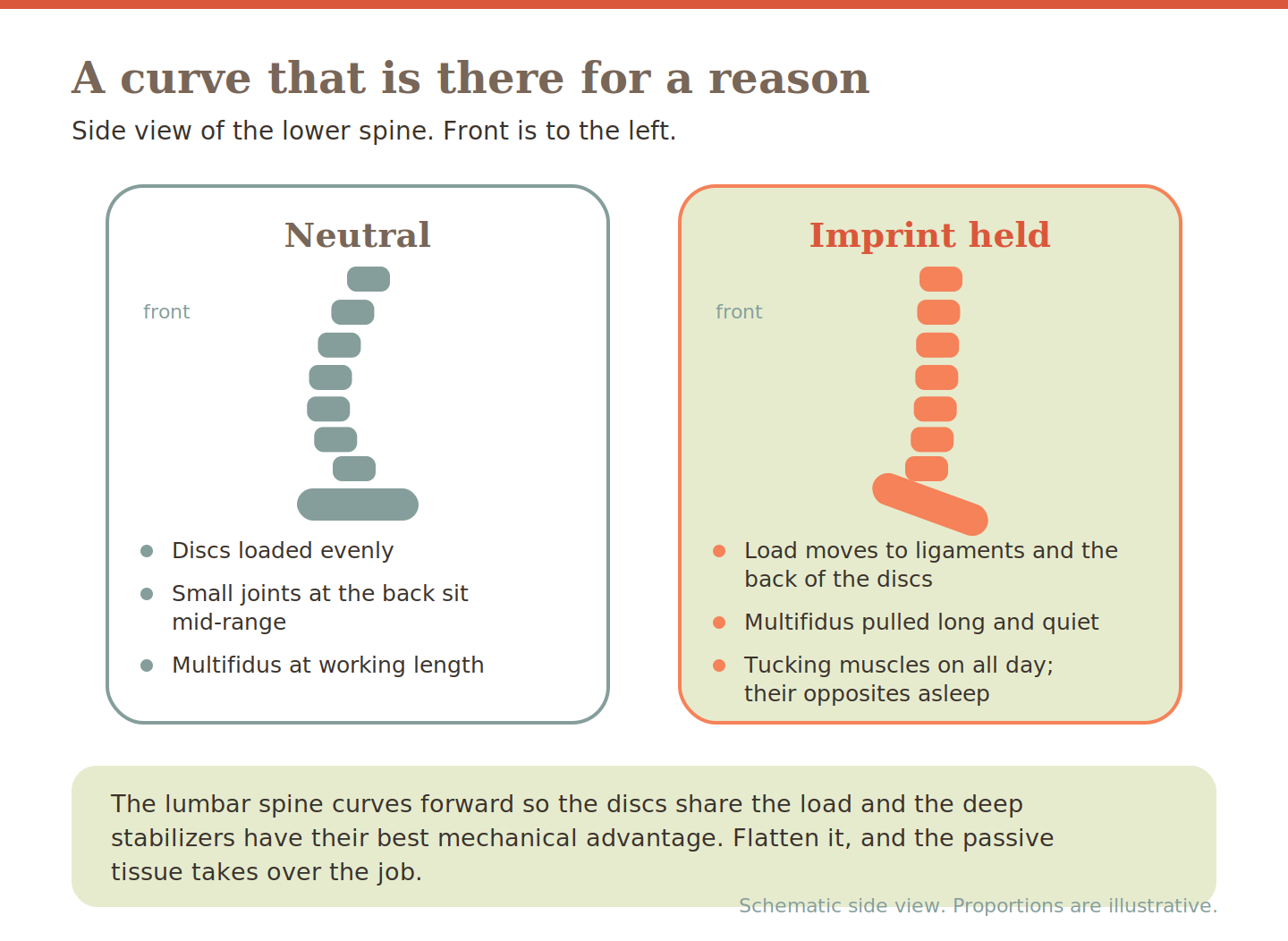
Why a flat back is a tired back
The lumbar spine curves forward for a reason. In that curve, the discs are loaded evenly, the small joints at the back of each vertebra sit in their middle range, and the muscles on either side of the spine are at a length where they work efficiently. Manohar Panjabi described this as the neutral zone — the region of movement around which the passive structures offer little resistance and the muscles have to do the stabilizing.1 That sounds like a vulnerability. It is the opposite. It is the position where the reflexive muscles — the multifidus along the back of the spine and the transversus abdominis wrapping the front — have the best possible mechanical advantage. So when you are over imprinting, you are compromising the mechanical balance. Learn to do a small micro imprint using the low abs and kegel muscles as this is what your back and pelvis do when you walk! you rock in and out of imprint (small) and neutral with each leg swing.
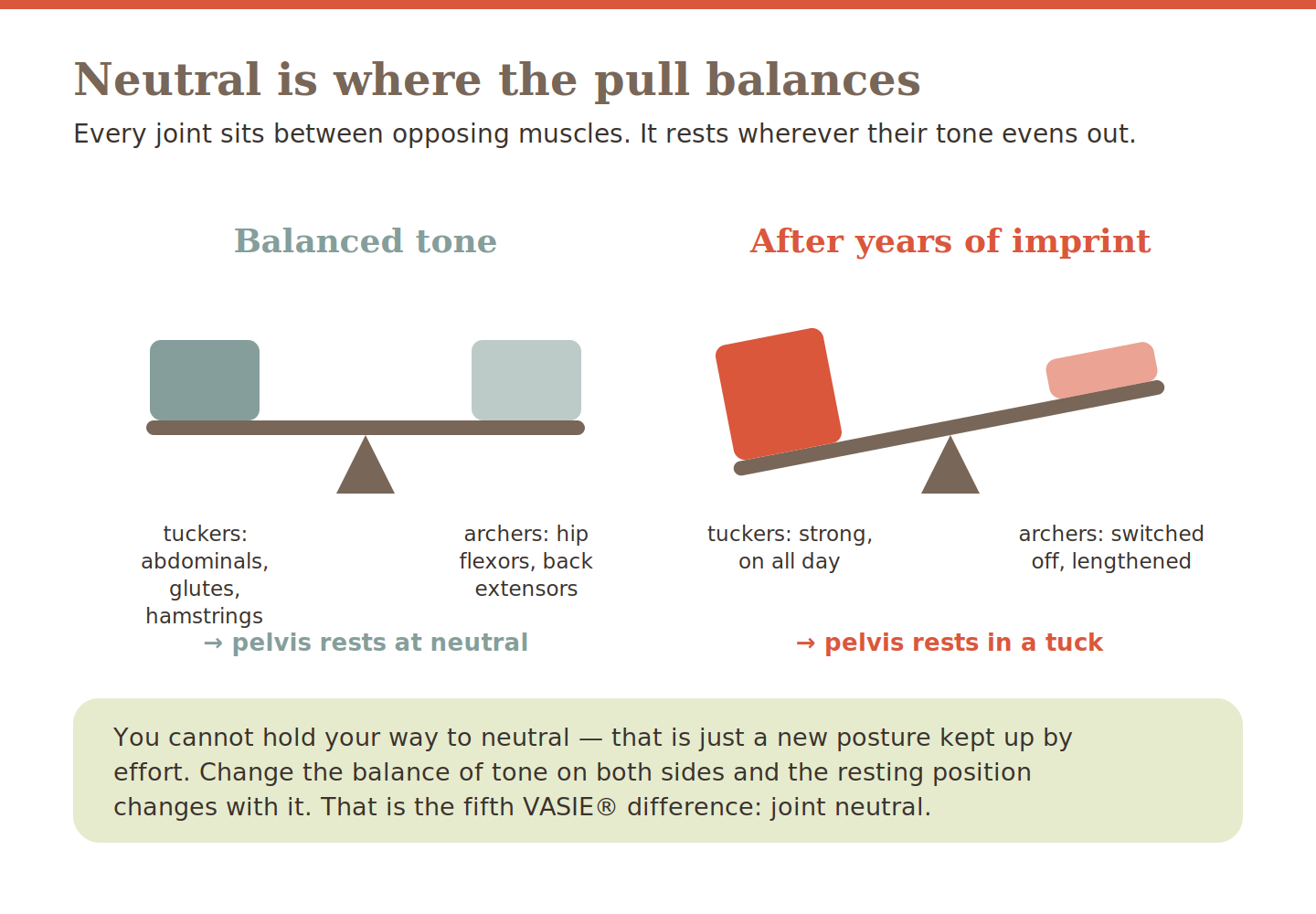
Tuck and flatten, and three things change. First, the multifidus is pulled long, and a lengthened stabilizer is a quiet one; the muscle that should hold each segment steady goes slack and hands the job to the ligaments and the back of the discs. Second, the muscles that produce the tuck — rectus abdominis, the obliques, the glutes and hamstrings — are now on all day. Their opposites, the hip flexors and the deep back extensors, are switched off and lengthened. That is a pelvis with one side of every pair braced and the other side asleep. Third, because the surface abdominals are holding everything, the deep transversus abdominis never gets the signal to lead. It is doing what I described two weeks ago as the core equivalent of shouting at a late alarm clock.
The multifidus matters more than most people know. After even a single episode of low back pain it shrinks on the painful side, and it does not recover on its own once the pain resolves.2 Six years of a posture that keeps it lengthened and unloaded is not going to bring it back. Dana's abdominals were doing the work of a muscle that had stopped showing up.
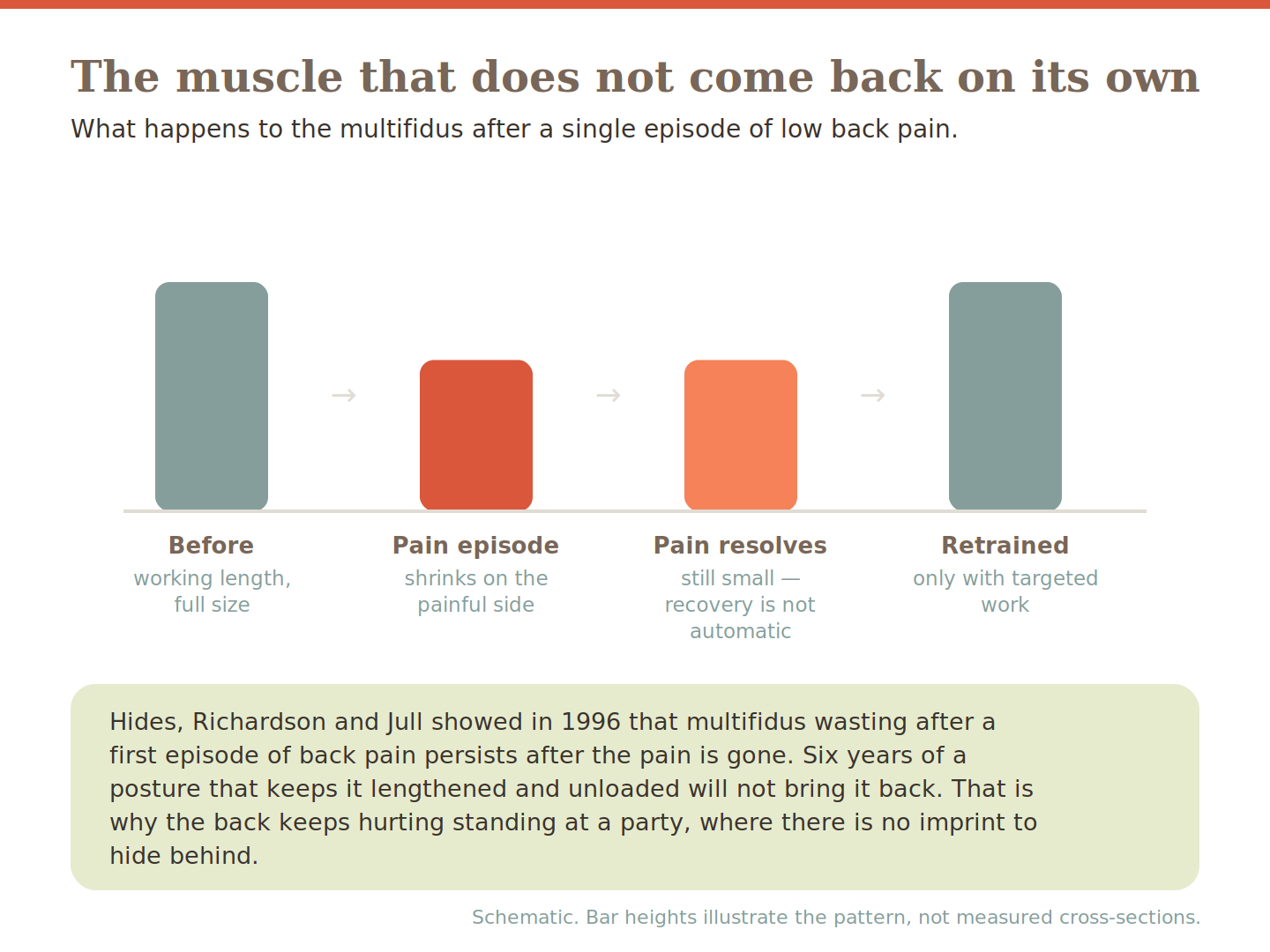 After a first episode of back pain, the multifidus does not recover on its own.
This is why her back hurt standing at a party. Standing has no imprint. The moment she stopped actively tucking, there was nothing underneath to hold the spine — the deep system had been trained out of the job — so the ligaments and the joints took the load and complained about it. Her strength was real. It was aimed at the wrong position.
Joint neutral is a skill, not a shape
The fifth of the six VASIE® differences is lasting postural change through joint neutral, and it is built on one idea from Structural Integration: every joint is surrounded by pairs of opposing muscles, and the joint will rest wherever the pull between those pairs balances out. Change the balance of tone, and the resting position changes with it. Neutral is not a place you hold. It is where the joint settles when both sides are equally awake.
Dana's pelvis rested in a tuck because the tucking muscles had more tone than the arching ones. Telling her to "find neutral" would have produced a new posture held by effort, no better than the old one. What we did instead was work each pair at its end range, in small increments: load the hip flexors and back extensors while the abdominals and glutes lengthened, then the reverse, slowly, on the reformer, with the exhale leading. At end range, one side of the joint is working while the other is stretched, and the nervous system builds a clearer map of both. Over weeks, the two sides arrive at equal tone. The pelvis drifts to neutral on its own — not because Dana is thinking about it, but because that is now where the pull balances.
Two places get outsized attention in this work: the feet and the hips. The balance between the flexors and extensors at those joints changes the posture of everything above them. Dana's tuck, it turned out, started with tight hamstrings and a foot that never fully pressed into the ground — twenty years of running had built a runner's pattern that the mat class then reinforced.
What changed, and what didn't
The first thing Dana had to unlearn was the tuck itself, which felt to her like letting go of her abs. It wasn't. It was letting the surface muscles stop so the deep ones could be found. In week three she could stand in neutral for a few minutes before the tuck crept back. By the end of her first sixteen-week cycle she could sit through a movie. By the second cycle she was running again — shorter distances, with a back that no longer decided when she stopped.
What I told her at the start, and what I'll tell you: this is months. Neutral is a range, not a point, and finding it is a skill that improves with repetition the way a golf swing does. It also holds. Once the tone on both sides of a joint is balanced, the body defaults there, and clients who stop for a season and return have mostly kept it.
If your back pain comes with numbness, weakness, leg pain below the knee, or changes in bladder or bowel control, see a physician before you see me. Recurring pain that has been imaged and cleared is the pattern I have described here, and it responds well. Nothing in this post replaces the care of a physical therapist; several of the ones my clients see have helped shape these exercises.
What we've measured
Since 2000, more than 10,000 clients have trained in VASIE®. Across hundreds of two-week breath-based intensives we measured height and abdominal circumference before and after,* and analyzed posture on video. Pelvic tilt moved toward neutral in most participants, and the height gains we recorded — typically a fraction of an inch — are what you would expect when a flattened or over-arched lumbar spine recovers its curve. Most of those participants were not told to imprint, and were not told to find neutral either. They were given the exercises and the breath, and neutral arrived.
* Day one and day six of class, standing, after a normal exhale: low abdomen (hip bone to hip bone), waist, and lower rib cage. In-house measurements, not a controlled trial.
Find out where your pelvis is resting
Studio One VASIE® Pilates
Pilates 101 is a small class, and we look at every pelvis in the room. If you've been tucking for years, you'll know within the first session.
Book Pilates 101VASIE® Pilates Online
Over-imprinting is the first of seven mistakes in the free Flat Abs Fast mini course. The two-minute self-assessment will show you whether you're doing it, and the 27-minute session teaches the alternative.
Start the free mini courseAna Kokaurova is a Certified Advanced Rolfer®, a Stott-certified Pilates instructor, and a VASIE® Pilates Instructor Trainer. She has been teaching since 2000 and co-developed the VASIE® method — Van Alstine Structural Integration Exercise — which combines the principles of Rolfing® Structural Integration with the exercise system developed by Joseph Pilates.
References
- Panjabi MM. The stabilizing system of the spine. Part II. Neutral zone and instability hypothesis. Journal of Spinal Disorders. 1992;5(4):390–397.
- Hides JA, Richardson CA, Jull GA. Multifidus muscle recovery is not automatic after resolution of acute, first-episode low back pain. Spine. 1996;21(23):2763–2769.
Stay connected with news and updates!
Join our mailing list to receive the latest news and updates from our team.
Don't worry, your information will not be shared.
We hate SPAM. We will never sell your information, for any reason.